

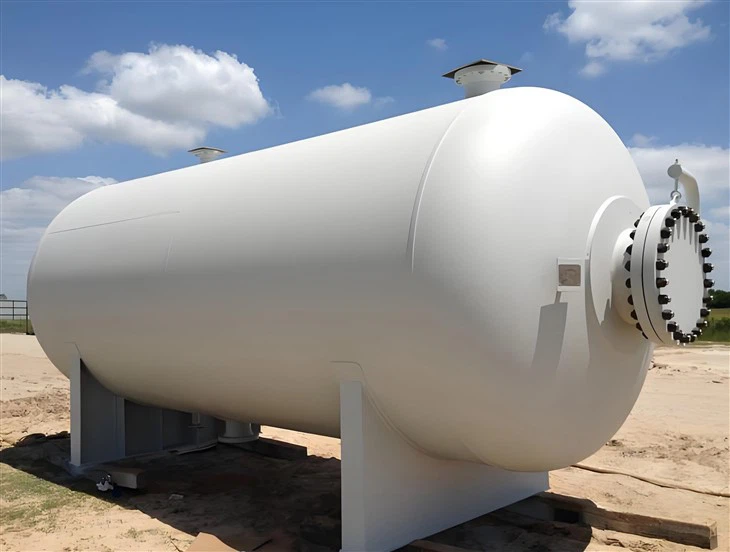
Specifications
Titanium Pressure Vessel is a container designed to hold gases or liquids at a pressure substantially different from the ambient pressure, where the primary pressure-retaining structural components are constructed from titanium or titanium alloys. These vessels are engineered to strict safety codes and standards (such as ASME Boiler and Pressure Vessel Code, Section VIII, or PED in Europe) due to the stored energy and potential hazards.
Titanium Pressure Vessel is a type of container or tank designed to hold gases or liquids at a pressure significantly higher than the surrounding atmosphere. These vessels are made from titanium alloys to take advantage of the material's exceptional properties, such as strength, corrosion resistance, and lightweight nature. Titanium pressure vessels are commonly used in industries where conventional materials like steel or aluminum would degrade due to exposure to extreme environments or chemicals.
Material
Titanium Grade
Common grades include Grade 2 (commercially pure) and Grade 5 (Ti-6Al-4V alloy). Other titanium alloys may be used depending on the required strength and corrosion resistance.
Corrosion Resistance
Excellent resistance to a wide range of corrosive substances, including seawater, acids, and gases like hydrogen.
Dimensions
Diameter
Customizable based on the application, typically ranging from small (a few inches) to large (several meters) in diameter.
Length
Varies depending on the required capacity, typically from 1 meter to several meters.
Wall Thickness
Usually between 5 mm and 50 mm, depending on the internal pressure requirements and size of the vessel
Pressure Rating
Pressure ratings typically range from 10 MPa (megapascals) to 200 MPa, but this can vary depending on design.
The design pressure is determined by factors such as the vessel's diameter, material strength, and thickness.
Temperature Range
Service Temperature: Typically from -196°C to +600°C, depending on the titanium alloy used.
Design Features
● Shape: Generally cylindrical or spherical, with hemispherical or torispherical ends to optimize pressure containment
● Internal Lining: In some cases, a corrosion-resistant lining (e.g., ceramic, polymer) may be added.
● Welded Construction: Often welded using specialized techniques, such as TIG (Tungsten Inert Gas) or Electron Beam Welding, to maintain structural integrity and corrosion resistance.
● Flanged or Threaded Ends: For connecting to pipelines, pumps, or other equipment.
Compliance Standards
ASME Boiler and Pressure Vessel Code (BPVC)
Many titanium pressure vessels are built to comply with this standard for safety and design reliability.
ISO 9001
Quality management standards to ensure manufacturing precision.
Inspection & Testing
● Non-Destructive Testing (NDT): Such as ultrasonic testing (UT) and X-ray inspection to check for defects and ensure the structural integrity.
● Hydrostatic Testing: Commonly used to test the vessel's ability to handle the designed pressure.
Applications
● Chemical Processing: For handling corrosive substances under high pressure.
● Aerospace: For fuel and hydraulic systems.
● Marine: Underwater equipment, especially for deep-sea exploration or subsea applications.
● Nuclear: For safe containment of reactive materials under high pressure
Hot Tags: titanium pressure vessel, China titanium pressure vessel manufacturers, suppliers, factory, MMO Titanium Mesh, Titanium Electric Heater, Titanium Electrolyzer, Titanium Filtration Equipment, Titanium Heat Exchanger Equipments, Titanium Reactor Equipment


