

As a seasoned supplier of titanium targets, I've been asked countless times about the electrical conductivity of titanium targets. This topic is not only of academic interest but also has practical implications for various industries that rely on these targets. In this blog post, I'll delve into the electrical conductivity of titanium targets, exploring its factors, measurement, and significance in different applications.
Understanding Electrical Conductivity
Electrical conductivity is a measure of a material's ability to conduct an electric current. It is the reciprocal of electrical resistivity, which is the resistance of a material to the flow of electric current. Conductivity is typically expressed in siemens per meter (S/m) or micro - siemens per centimeter (μS/cm).
Titanium is a transition metal with unique physical and chemical properties. Its electrical conductivity is influenced by several factors, including its purity, crystal structure, and temperature.
Factors Affecting the Electrical Conductivity of Titanium Targets
Purity
The purity of a titanium target plays a crucial role in determining its electrical conductivity. Impurities in titanium can act as scattering centers for electrons, reducing the overall conductivity of the material. High - purity titanium targets, with fewer impurities, generally have higher electrical conductivity. For example, commercially pure titanium (CP Ti) with a purity of 99.5% or higher has better conductivity compared to titanium alloys that contain other elements such as aluminum, vanadium, or iron.
Crystal Structure
The crystal structure of titanium also affects its electrical conductivity. Titanium can exist in two main crystal structures: hexagonal close - packed (hcp) at room temperature and body - centered cubic (bcc) at high temperatures. The hcp structure is more common in titanium targets. The arrangement of atoms in the crystal lattice influences the mobility of electrons. A well - ordered crystal structure allows for more efficient electron movement, resulting in higher conductivity.
Temperature
Temperature has a significant impact on the electrical conductivity of titanium targets. As the temperature increases, the thermal vibrations of atoms in the crystal lattice become more pronounced. These vibrations can scatter electrons, reducing their mobility and thus decreasing the electrical conductivity. Conversely, at lower temperatures, the thermal vibrations are reduced, and the conductivity increases.
Measuring the Electrical Conductivity of Titanium Targets
There are several methods to measure the electrical conductivity of titanium targets. One of the most common methods is the four - point probe technique. In this method, four probes are placed in contact with the surface of the titanium target. A current is passed through the outer two probes, and the voltage is measured across the inner two probes. Using Ohm's law (V = IR), the resistance of the material can be calculated, and from the resistance, the conductivity can be determined.
Another method is the eddy - current testing. This non - destructive testing method uses electromagnetic induction to measure the electrical conductivity of the titanium target. An alternating current is passed through a coil, creating a magnetic field. When the coil is placed near the titanium target, eddy currents are induced in the target. The magnitude of the eddy currents is related to the electrical conductivity of the material.
Significance of Electrical Conductivity in Different Applications
Physical Vapor Deposition (PVD)
Titanium targets are widely used in PVD processes, such as sputtering and evaporation, to deposit thin films on various substrates. In sputtering, a high - energy plasma is used to bombard the titanium target, causing titanium atoms to be ejected and deposited on the substrate. The electrical conductivity of the titanium target affects the efficiency of the sputtering process. A target with higher conductivity can better conduct the electrical current required to maintain the plasma, resulting in a more stable and efficient sputtering process.
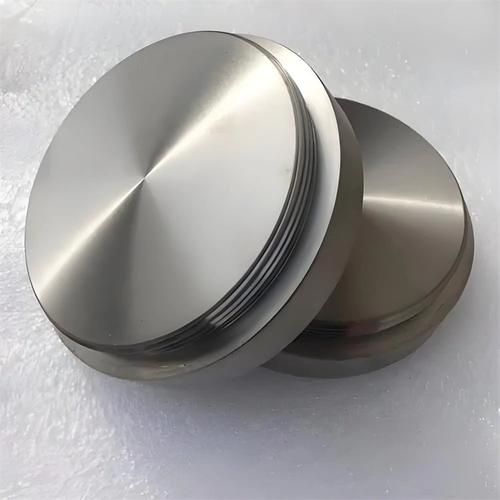
For example, in the production of decorative coatings on watches or jewelry, Titanium Circular Target with good electrical conductivity can ensure a uniform and high - quality coating.
Electronics
In the electronics industry, titanium targets are used in the fabrication of semiconductor devices and printed circuit boards. The electrical conductivity of the titanium target is important for ensuring proper electrical connections and signal transmission. For instance, in the production of integrated circuits, a titanium target with high conductivity can help reduce resistance and improve the performance of the electronic components.
Medical Applications
Titanium is widely used in medical applications due to its biocompatibility. In the production of medical implants, such as dental implants and orthopedic implants, the electrical conductivity of the titanium target can affect the performance of the implant. Although the electrical conductivity is not the primary concern in medical applications, it can still play a role in some cases, such as in the development of smart implants that require electrical conductivity for sensing or communication purposes.
Our Titanium Target Offerings
As a leading supplier of titanium targets, we offer a wide range of products, including Titanium Tube Target, Titanium Plate Target, and Titanium Circular Target. Our targets are made from high - purity titanium, ensuring excellent electrical conductivity and other physical properties.
We understand the importance of electrical conductivity in different applications, and we strive to provide our customers with the highest - quality titanium targets. Our manufacturing processes are carefully controlled to ensure the consistency and reliability of our products.
Conclusion
The electrical conductivity of titanium targets is a complex property that is influenced by factors such as purity, crystal structure, and temperature. Understanding the electrical conductivity of titanium targets is essential for various industries, including PVD, electronics, and medical applications. As a supplier of titanium targets, we are committed to providing high - quality products with excellent electrical conductivity to meet the diverse needs of our customers.

If you are interested in purchasing titanium targets or have any questions about their electrical conductivity, please feel free to contact us. We look forward to discussing your requirements and providing you with the best solutions.
References
- ASM Handbook, Volume 2: Properties and Selection: Nonferrous Alloys and Special - Purpose Materials. ASM International.
- "Titanium: A Technical Guide" by John C. Williams. ASM International.
- "Electrical Conductivity of Metals" by David R. Lide. CRC Handbook of Chemistry and Physics.